
THE LAYERING GUIDE
Minimalist Layering Necklaces
A good layered stack looks unplanned and is not. It depends on three things: enough space between lengths that each chain reads on its own, enough difference in link shape that the layers do not blur together, and restraint about how many you add. Get those three right and two chains look composed; get them wrong and three chains look like one thick one.
The chains below are handmade to stack: graphic links, two lengths, brushed and oxidized finishes that sit well against each other. Each is made one at a time in my Kansas City studio and ships anywhere in the USA. The guide comes first, because the rules are what make the pieces work; the chains follow.

How to layer necklaces
Five rules. Each one stands on its own, and together they are the whole method.
Start with spacing, not with pieces
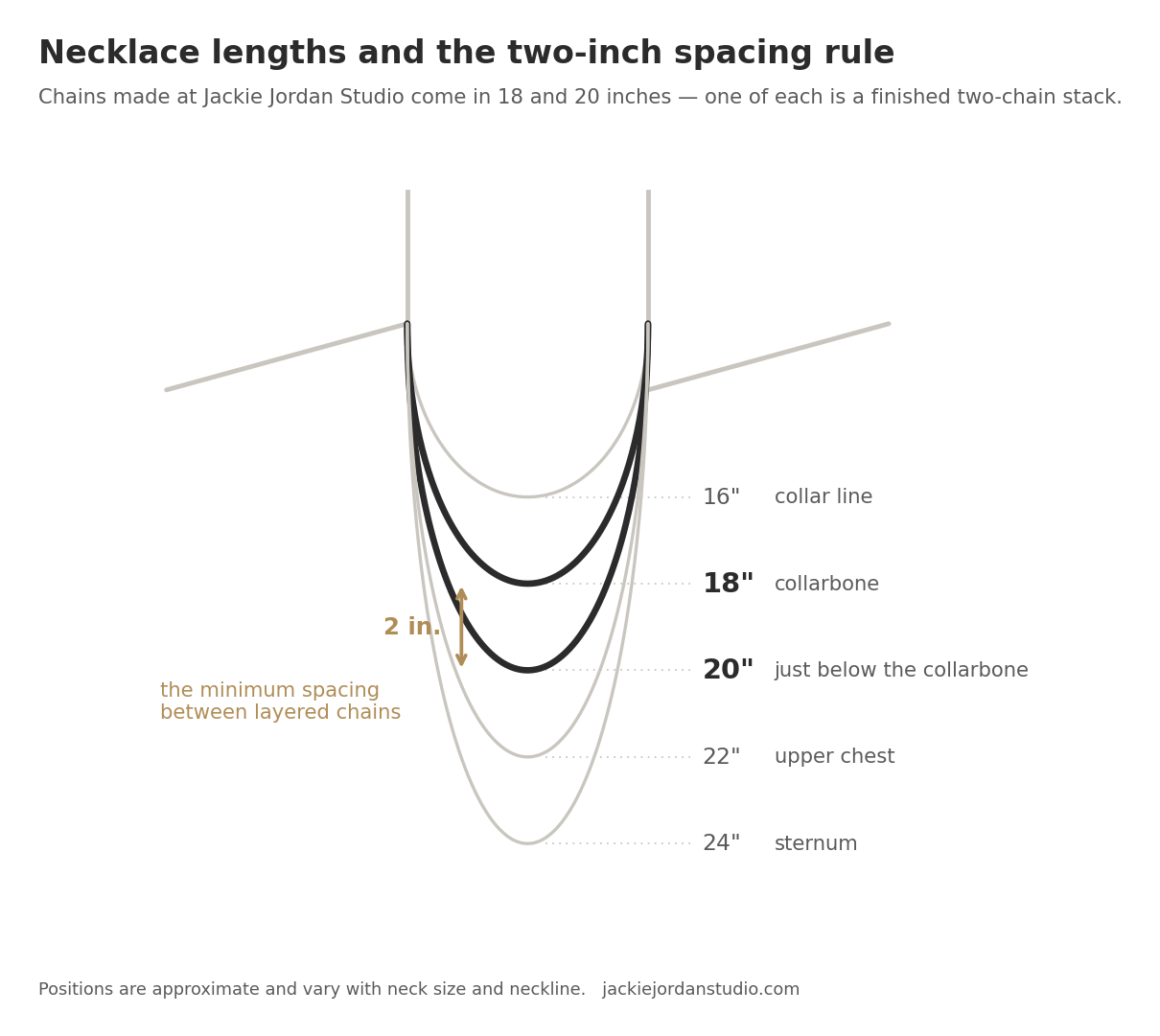
Two chains need at least two inches between them. Three chains need roughly two inches between each. An 18-inch and a 20-inch is the easiest starting pair: visible separation, no tangling, and both lengths sit within the collarbone-to-sternum zone where a stack reads best. Anything closer than two inches and the layers read as one thick chain.
Vary the link, not just the length
If both chains use the same link, layering only doubles the piece. Pair a rounded link with a flat one (a Raindrop Chain against a Simple Paperclip Chain) and each stays legible. Contrast in shape is what makes a stack look composed rather than accidental.
Mix finishes deliberately
Brushed and oxidized sterling together is the most reliable combination in my work: one holds a soft matte light, the other reads nearly charcoal, and the difference between them gives the stack depth. Adding a gold-accented piece as a third layer works: as the accent, not as an equal third. Silver and gold mixed metal jewelry is at its best when the gold is the detail.
Anchor with one piece that carries weight
A stack needs a focal point. Set the shortest chain as the graphic one and let the longer chains stay quiet beneath it, or invert it and let a longer statement piece anchor the bottom. What does not work is three chains of equal visual weight; the eye has nowhere to land.
Stop at three
Two is elegant. Three is the ceiling for minimalist layering. Beyond that the negative space disappears, and negative space is the whole point of a minimalist stack.
Why these chains layer well
Most chain sold as "layering jewelry" is uniform rope in three lengths, and rope layered on rope is the reason so many stacks look like tangle. The chains here are drawn as individual links (raindrops that catch light along their curve, flat paperclip ovals that lie flush and elongate the neckline): forms with a shape you can actually see at arm's length. That is what lets two chains sit together and still read as two chains.
Each is made by hand in sterling silver, in small runs, by one maker. The two standard lengths, 18 and 20 inches, are not arbitrary: they are the two-inch spacing rule built into the catalog, so that one of each is a finished stack with nothing to adjust.
Three stacks built from this collection
Every combination below uses only pieces in the grid, so each one can be ordered as written.
The easy two
Raindrop Chain at 18 inches and Simple Paperclip Chain at 20 inches. Different link shapes, two inches of separation, and it works with a crew neck or an open collar. If you buy one stack from this page, buy this one.
The mixed-finish two
The same pairing with one chain brushed and one oxidized. Matte light against near-charcoal is the version to recommend to anyone unsure where to start. The finish contrast does the composing for you.
The anchored three
Raindrop at 18 inches, Simple Paperclip at 20 inches, and Paperclip Necklace No. 1 as the graphic piece on top. Keep the two chains quiet and let the statement piece do the work. This is the ceiling: three pieces, one focal point, and the negative space still intact.
Handmade in Kansas City, shipped across the USA
Jackie Jordan Studio is one maker, me, designing and fabricating every chain by hand at my bench in the Kansas City metro. Nothing here is bought in and re-sold: the links are formed, the surfaces brushed or oxidized, and the clasps finished in the studio. Small variations between two of the same chain are the mark of that process.
Every piece ships throughout the United States, packaged ready to give. Kansas City customers are welcome to get in touch to see pieces in person before choosing a stack. The full necklace collection is on its own page, and the story of how a thirty-year career in color and design became a jewelry studio is on the about page.
Layering questions
How many necklaces should I layer?
Two or three. Two is the most versatile and the easiest to get right; three is the maximum before a minimalist stack starts reading as clutter. If you are starting out, wear two for a month before adding a third; most people find two is the answer.
What lengths layer best together?
An 18-inch and a 20-inch chain for a two-chain stack. For three, add a longer piece with at least two inches of separation from the one above it, or use a shorter graphic piece on top as the anchor. The two-inch rule is the one that matters; the specific numbers follow from your neckline.
Can I mix silver and gold necklaces?
Yes. Mixed metals are part of my work: gold appears as an accent throughout the collection, and a gold-accented piece sits well in a stack of brushed and oxidized silver. Treat the gold as the detail in the stack rather than as an equal third element, and the mix reads as deliberate.
Will layered chains tangle?
Adequate spacing between lengths is what prevents tangling: two inches or more. Chains with distinct link shapes also slide past each other more cleanly than two identical ropes, which is one more reason the Raindrop and Simple Paperclip pair well. Take the stack off as one unit and lay it flat to store it.
Are these layering necklaces handmade in the USA?
Yes. Every chain is designed and made by hand in Kansas City, Missouri, by one maker, and ships throughout the United States. There is no production line; the two standard lengths and two finishes are made in small runs at the studio bench.
Which chain should I buy first?
The Simple Paperclip Chain at 20 inches. Its flat link lies flush, it works alone with any neckline, and it is the base that every combination on this page is built on. Add a Raindrop Chain at 18 inches when you are ready for a second layer.